
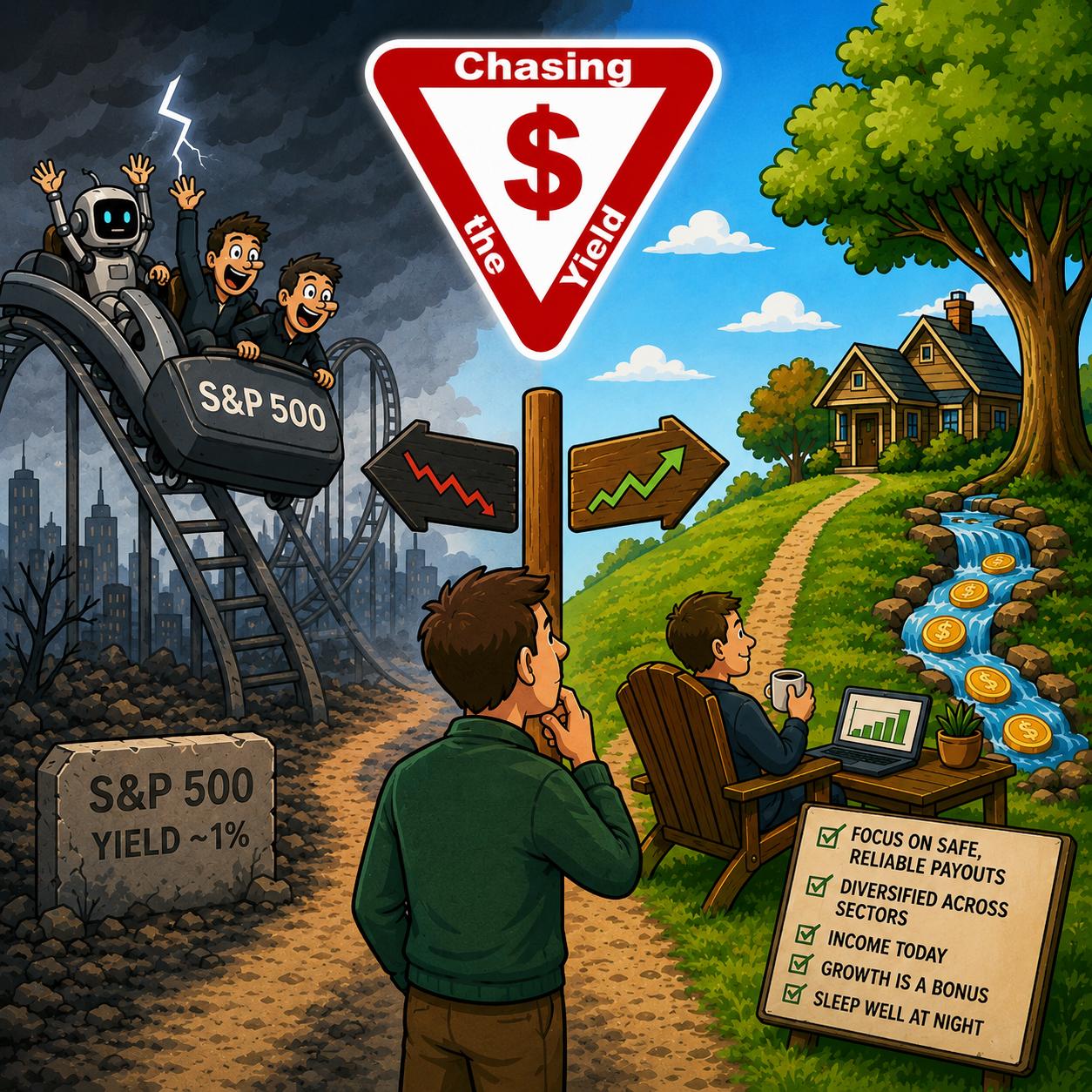
A recent Wall Street Journal piece got me thinking about this question. The article, “Blame AI for the Strange Death of Dividends,” pointed out something striking: the S&P 500 Dividend Aristocrats, companies that have raised their dividend every year for at least 25 years, have lagged the broader index by the widest margin since the dot-com bubble peaked in 2000. The reason is the S&P 500 has become dominated by AI and tech companies that plow their cash back into growth instead of paying it out. Half of this year’s twenty best-performing stocks in the index pay no dividend at all, including the two best performers, Sandisk and Intel. Dividends on the S&P 500 sit at just over 1%, barely above their all-time low set in 2000.
The author framed this as a question worth asking: is this a feature or a bug? Investors who stuck with steady dividend payers missed the AI boom. They also would have missed the next crash, if this turns out to be a bubble the way 2000 and the post-pandemic tech rally both were.
Listen to this episode here
My reaction to the article was different from the question it posed. I don’t measure myself against the S&P 500 at all. My IRA currently yields over 4%. My taxable brokerage account yields around 6%. I built both portfolios by looking at solid, reliable companies and funds that sit outside the index entirely. The article made me realize that a lot of investors only shop inside the S&P 500, as if it were the only available menu. With a bit more digging, you can do far better than 1%, and you don’t have to take on reckless risk to get there.
That gap between what’s possible and what most people settle for comes down to a deeper question: why do you actually invest?
The Question That Changed How I Invest
For a long time, I stayed away from the stock market because I considered it gambling. Buying a stock because you expect the price to go up later, with no real way to know if it will, felt like betting on a number. I wasn’t comfortable putting my money on something I couldn’t reason through.
What changed my mind was discovering dividend income investing. Once I understood it, the whole picture clicked into place. When you buy a share of a company, you become a part owner of that business. As an owner, you’re entitled to a share of the profits the company generates. You’re buying a piece of a profitable operation and getting paid your share of what it earns.
I still want the share price to rise over time, and for most of my holdings it has. That’s a bonus. I invest for the income the company or fund pays me. The dividend is the business sharing its results with its owners. The price is what other people are willing to pay on a given day, and that number swings around for reasons that often have nothing to do with how the underlying business is actually doing.
This is why the WSJ article doesn’t shake my approach. The article measures dividend investors against the S&P 500’s price return, the same way you’d measure two gamblers against each other by who picked the bigger number. My scorecard is the income showing up in my account every month. It isn’t how my account balance compares to an index where a growing share of the biggest names pay no dividend at all.
What My Portfolio Actually Looks Like
My IRA holds 55 positions and generates a 4.22% yield. My taxable account holds 50 positions and generates a 5.97% yield. Compare that to the S&P 500’s 1.2% or the Dividend Aristocrats’ 1.3%, and the difference is pretty large.
I didn’t get there by just reaching for yield. Utilities and financials make up over half of both portfolios combined, with energy, real estate, and consumer staples filling out most of the rest. Technology accounts for barely 1% of what I own. These are steady, often regulated or recession-tested businesses that generate cash whether the economy is booming or struggling. I judge each one by whether the payout is safe and durable first, and I only look at growth and valuation after that. Chasing the highest possible return sits near the bottom of my priority list.
Questions Worth Asking Yourself
If you’re trying to figure out what kind of investor you are, or what kind you want to be, these are the questions that matter most.
Do you invest because you like the thrill of picking a high flyer and watching it take off? It’s worth being honest with yourself about whether that’s what’s driving your decisions, because gambling and investing for income require completely different approaches and completely different stocks.
Do you need this money to live on, or is it money you won’t touch for decades? That answer changes everything about how much risk makes sense for you. Money you’re living off today calls for a different approach than money that has thirty years to ride out the market’s mood swings.
Would you be okay watching the price drop 30% if the dividend kept paying the whole way through? If that price drop would scare you into selling, you’re still primarily invested in the price, no matter what you tell yourself about the dividend.
Are you buying a stock because of a story you find exciting, or because you’ve looked at the business’s actual cash flow and decided it can keep paying you? A story can be true and still not pay you anything for years, if ever. Cash flow either supports a payout or it doesn’t.
How would you feel checking your account during a real crash? If your honest reaction is relief that the income keeps showing up regardless of what the balance says, you’re probably an income investor at heart. If your reaction is panic about the number on the screen, the price is what actually matters to you, and that’s worth knowing about yourself before the next downturn arrives rather than during it.
None of these questions have a right answer that applies to everyone. They have a right answer for you, and figuring out what that is matters more than what anyone else, including me, does with their own money. I found my answer when I stopped trying to guess where a stock price was headed and started looking at whether the business behind it could keep paying me. That question is the one that finally made investing make sense to me, and it’s the one I’d encourage every reader to sit with before deciding what kind of investor they want to be.
Disclaimer
ChasingTheYield.com and Kevin Bae are not registered investment advisors, brokers or dealers. Kevin Bae may have positions in any financial instrument, product, or company mentioned on chasingtheyield.com or on the Chasing the Yield podcast. Information provided by chasingtheyield.com and the Chasing the Yield Podcast is provided for information and entertainment purposes only and are not intended as advice or a recommendation or an offer or solicitation for the purchase or sale of any security or financial instrument. All opinions are based upon sources believed to be accurate and are provided in good faith. No warranty, representation, or guarantee, expressed or implied, is made as to the accuracy of the information contained herein. Past performance is not an indicator of future results.
Please contact an investment professional if you have any questions regarding an investment.
Contact
For questions or comments contact me at mail@chasingtheyield.com