
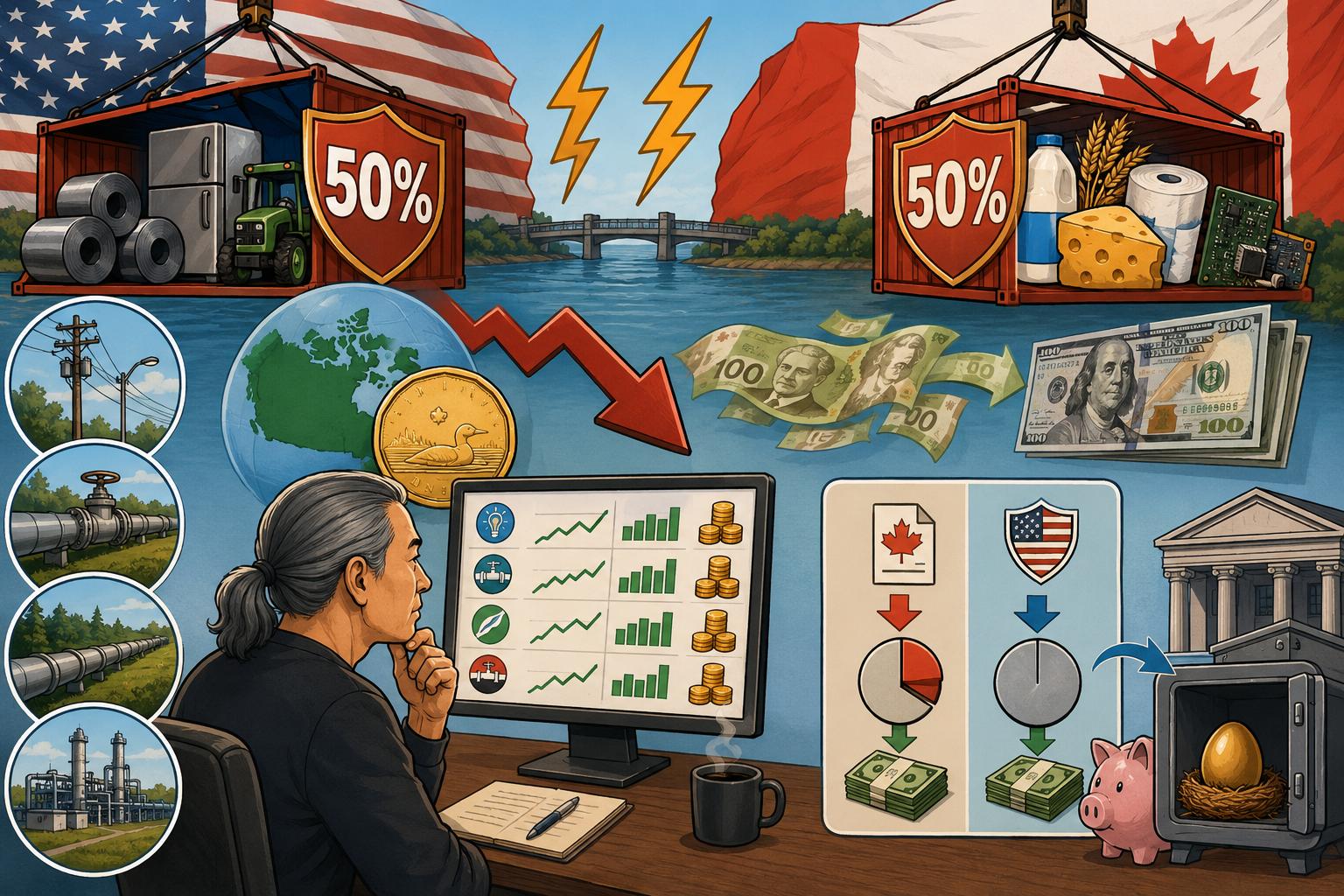
Unless you’ve been living under a rock you probably heard the trade relationship between the United States and Canada broke down this month. The U.S. imposed a 50% tariff on roughly $20 billion of Canadian goods on August 22 and Prime Minister Mark Carney announced Canada will respond with matching tariffs on U.S. goods starting September 8. The Canadian dollar dropped against the U.S. dollar within hours of the announcement.
The tariffs on both sides target sectors like steel, dairy, appliances, agricultural equipment, pulp and paper, and electronics. Energy is not on the current list. Some analysts have floated the idea that Canada could restrict energy exports to the U.S. as a further escalation if the standoff drags on. That escalation risk matters most for investors holding Canadian pipeline and utility companies, since those are the businesses most exposed to cross-border energy trade. For now, currency and taxes are the more immediate concern for Canadian dividend holdings.

My own portfolio holds four Canadian dividend payers: Fortis, TC Energy, Enbridge, and Pembina Pipeline. Combined, they make up a little over 4% of total invested assets, split across a utility and three midstream energy names. None of these are large positions individually. Fortis sits at roughly 1.4%, Pembina around 1.7%, Enbridge under 1%, and TC Energy under half a percent of the total portfolio.
Each pays its dividend in Canadian dollars, which gets converted to U.S. dollars when it hits my U.S. brokerage account. A weaker loonie (slang for a Canadian dollar. Who knew?!?) means the same Canadian dollar dividend converts to fewer U.S. dollars, even though the payout hasn’t changed. This is currency risk, and it sits underneath every Canadian holding regardless of how the underlying business performs. A trade war that pushes the Canadian dollar lower reduces the U.S. dollar value of every dividend check from these four names until the currency stabilizes or recovers.
The dividend quality picture across these four names varies more than the yields suggest. Enbridge carries a 73-year uninterrupted dividend history with 30 straight years of increases, which places it among the more durable payers in the group. Pembina has a shorter growth streak. Fortis has grown its dividend for 52 consecutive years, a track record that puts it in rare company among any dividend payer, U.S. or Canadian. TC Energy is the outlier, showing a reset growth streak after a period of corporate restructuring, worth watching.

Every dividend paid by a Canadian corporation to a U.S. investor gets taxed at the source by the Canadian government before it ever reaches a brokerage account. The default rate under Canadian law is 25%. The Canada-U.S. tax treaty reduces that to 15% for U.S. residents, provided the broker has filed the correct paperwork, typically a form called an NR301, on the investor’s behalf. Most major brokers handle this automatically, though it’s worth confirming directly with your broker, since this is exactly the kind of process that runs in the background until an investor goes looking for it.
Retirement accounts get different treatment. The same treaty that exempts a U.S. dividend held inside a Canadian Registered Retirement Savings Plan (RRSP) from U.S. withholding also exempts Canadian dividends held inside a U.S. IRA from Canadian withholding. A Canadian stock held in a taxable brokerage account loses 15% of every dividend to Canadian withholding tax before the money arrives, recoverable at tax time through the foreign tax credit. The same stock held in an IRA arrives with no withholding at all, since the treaty treats the IRA as a recognized retirement plan.

This makes account placement a real decision for anyone building a position in Fortis, Enbridge, TC Energy, Pembina, or any other Canadian dividend payer. Holding these names in a taxable account means dealing with the withholding and the foreign tax credit paperwork every year, a manageable but real drag on the dividend as it’s received. Holding the same names in an IRA sidesteps the withholding entirely, though the value of that advantage depends on the applicable tax bracket and account type.
Nothing about the current round of tariffs targets these four holdings today. The most immediate risk is a softer Canadian dollar reducing the U.S. dollar value of the dividends, alongside the ongoing question of which account type holds each Canadian position. A trade war that escalates into energy and potash restrictions would change the picture for TC Energy, Enbridge, and Pembina, since their businesses depend on moving Canadian resources across that border. Until then, check whether each Canadian holding sits in a taxable account or an IRA, and confirm the withholding treatment matches what it should be.